A dispute over Japan’s online mystery packs is drawing attention to a question often obscured by rising card prices: who is buying—the collector, the reseller, or an Oripa operator replenishing its prizes? All three can support the same card. They may not keep buying at the same pace when conditions weaken.
Cardstop reviewed the original legal announcement, public platform explanations and PSA Japan’s latest service notices to examine how Oripa businesses interact with the card market. On 7 September, Hibiki Law Office said it had asked Japan’s Consumer Affairs Agency to investigate five unnamed major online Oripa operators. A request for investigation is neither a government finding of wrongdoing nor an industry ban.[Hibiki announcement]
The research follows three links: how prize procurement creates demand, how point conversions affect the circulation of physical cards, and how grading costs and waiting times influence resale decisions. Each helps explain risks facing Hong Kong collectors. Public platform disclosures, however, do not quantify their impact on Hong Kong prices as a whole. The analysis distinguishes published arrangements from market scenarios that still require transaction evidence.
Contents
01
A request for investigation puts transparency in focus
The news concerns a law firm’s allegations and request for investigation. Hibiki cited suspected breaches of Japan’s Specified Commercial Transactions Act and concerns involving consumer contracts and advertising. Its announcement did not identify the five companies. The available document does not establish that any particular named brand is a target of the complaint.[7 September announcement]
As of the reporting cut-off, this review found no related penalty or suspension announcement in the agency’s relevant public releases. That does not establish that no action or investigation is under way. Similarly, litigation or criminal complaints mentioned as possible future steps by the firm should not be reported as completed actions.[Consumer Affairs Agency: 2026 releases]
These distinctions matter. An allegation, the opening of a regulatory investigation and a finding of illegality require different evidence and carry different implications. Compressing them into a headline about a Japanese ‘crackdown’ could lead readers to assess inventories, prices and trading partners on a false premise.
The wider question is what consumers know before paying. Prize specifications, draw costs, prize quantities, point conversions and delivery conditions should be understandable together. A prominent image of an expensive card or a large return percentage does not, by itself, show the chance of recovering the money spent.
When a screen places card valuations alongside platform points, users may confuse a point conversion with a cash resale value. The former depends on platform rules. The latter requires an outside buyer, an agreed transaction and payment. Meaningful disclosure should make that distance visible before a draw.
Operators also differ in their prize design, sourcing, delivery and finances. Without reliable company-specific evidence, one complaint cannot establish that every platform will cut purchases or that any particular business is in financial difficulty. Subsequent official documents and verifiable operational changes deserve attention.
02
Prize procurement creates a different kind of demand
Oripa turns randomly allocated prizes into paid draws. For an operator, a card is therefore both a collectible and something that attracts participation. A popular card featured in a pool can have two potential buyers: someone who wants to collect it, and a business that needs it for prize allocation and delivery.
Collectors and prize buyers do not make decisions on identical terms. A collector may hold a card for its character, artist, set or place in a collection. An operator may adjust prizes around campaigns, inventory and expected participation. Support from both groups does not mean either will buy indefinitely at any price.
More pools featuring a particular card could prompt operators to buy it from suppliers or the secondary market. Switching prizes to other cards, games or products could change that demand. This is a possible mechanism, not a measured market share: public procurement data are insufficient to quantify Oripa’s contribution to trading in individual Pokémon cards.
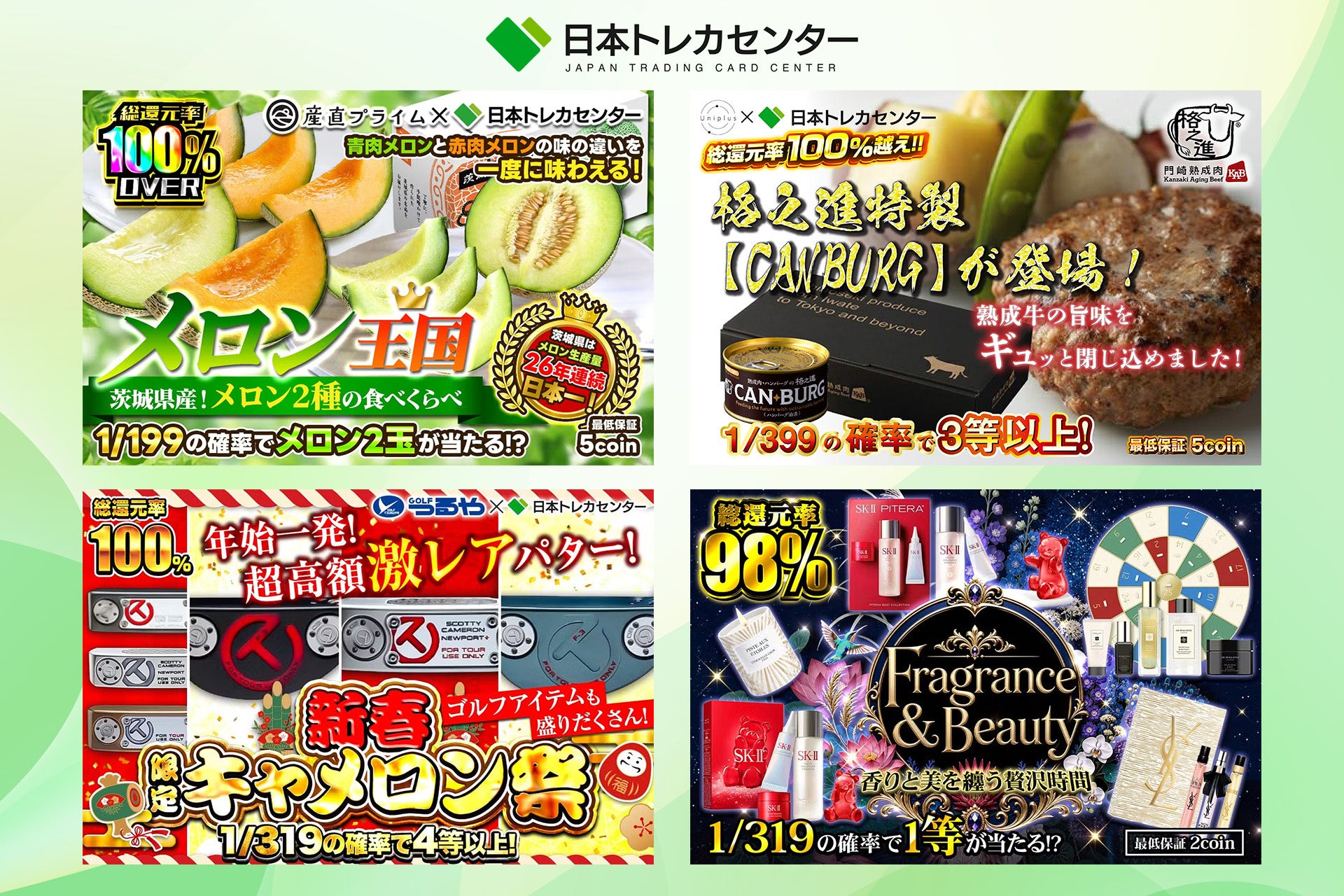
There is documented prize diversification. In June, Japan Toreca Center (日本トレカセンター) said it had introduced prizes including food, appliances and watches through more than thirty corporate partners over time. That illustrates a business extending beyond cards. It does not mean all those partnerships involve Pokémon or demonstrate falling demand for a specific card.[Japan Toreca Center’s June release]
If some operators reduce buying, cards that depend more heavily on prize procurement could face greater pressure. The effect would still depend on whether collectors, dealers and overseas buyers fill the gap. A challenge to operators is not evidence that every expensive card, every PSA 10 or the entire Pokémon market must fall together.
Different prizes serve different purposes. A valuable headline prize attracts attention, while other cards complete the pool. Testing whether Oripa supports lower-priced graded cards would require their quantities, actual deliveries and restocking data. Advertising only the top prize cannot establish that large volumes of less expensive PSA cards depend on platforms for buyers.
Supply can also move in opposing directions. More users requesting physical prizes and reselling them could increase cards available on the secondary market. Operators fulfilling those requests or replenishing inventory might also buy more. Whether extra deliveries create net selling pressure depends partly on how much purchasing accompanies them.
For Hong Kong, the relevant transmission channels include Japanese dealer bids, available stock and cross-border costs. Lower Japanese bids could weaken an external outlet for local sellers. Exchange rates, freight, collecting preferences and condition still matter: a Japanese-language card’s quote is not automatically the Hong Kong price of its English or ungraded counterpart.
Useful research would measure actual procurement, physical redemptions and subsequent completed resales. Counting draws or expensive cards in advertisements is insufficient. Without those data, the claim that Oripa supports card prices remains a hypothesis to test, rather than an established rule for the whole market.
03
Platform points are a step away from cash
Online Oripa combines payment, drawing, redemption and repeat participation in one interface. That convenience can obscure their different economic meanings. Japan Toreca Center describes choosing prize delivery or conversion into service points. Clove likewise explains converting unwanted prizes into points for further draws.[Japan Toreca Center][Clove’s guide]
Conversion does not establish a sale on the open market. Points provide purchasing power under platform rules; cash can meet obligations outside that service. A large point value does not mean the same amount has reached a bank account. Refundability, cash redemption and transferability require separate checks against the terms.
A balance usable under platform rules; not a cash offer from a buyer.
The seller’s proposed amount; a listing does not establish a completed sale.
The amount actually received after transaction fees and delivery costs.
Draw counts are therefore not a direct measure of fresh demand. After one top-up, a user might convert several prizes back into points and play again. Activity increases without a new external payment or physical shipment at every step. New deposits, points consumed, draw counts and goods delivered should be reported separately.
The exit route deserves thought before payment. Someone seeking a particular card needs to understand its specification, redemption deadline, delivery cost and arrival time. Someone seeking cash also needs a buyer, an acceptable resale price and time to complete the sale. Winning a highly valued prize does not complete those later steps.
The gap may widen in a weaker market. Platform point displays need not track every secondary-market sale, while dealers can adjust buying terms for stock and condition. A holder planning around an earlier valuation may receive a different offer when selling. Price and liquidity risk exist without assuming misconduct by a platform.
Keeping external payments, cash recovered, physical prizes received and unused points separate gives a clearer record. Assess physical goods against verifiable selling conditions and record points according to their permitted uses. Treating each conversion as fresh profit risks counting repeated circulation of the same original payment as several realised gains.
Operators also face costs. Falling card prices could lower future procurement costs while reducing existing inventory values. Revenue must cover prizes, marketing, payment processing and operations. Without verified accounts, neither a promotional return rate nor a market decline establishes a platform’s net profit or solvency. ‘The operator always wins’ is not a financial analysis.
04
PSA changes add cost and waiting-time considerations
Separately from the Oripa dispute, PSA Japan announced service changes on 10 September. Express rose from ¥22,980 to ¥29,980 per card, approximately 30.5%, for new applications from 1am Japan time that day. This is a change to a particular service, not an equivalent increase across every grading tier.[PSA Japan’s 10 September announcement]
For new applications from 7am Japan time on 15 September, Standard will cost ¥9,980 per card, with a ¥150,000 declared-value limit and an estimated 100 business days. Regular becomes Priority, with its estimate increasing from 60 to 80 business days. Existing applications before the relevant cut-offs retain their previous terms.[New services and effective times]
| Service | Announced change | New applications from |
|---|---|---|
| Express | ¥22,980 → ¥29,980 +30.5% | 10 Sep, 01:00 JST |
| Standard | ¥9,980 / card 100 business days* | 15 Sep, 07:00 JST |
| Regular → Priority | 60 → 80 business days* | 15 Sep, 07:00 JST |
*Estimated turnaround, not a guaranteed completion date. Standard has a ¥150,000 maximum declared value. Fees shown in JPY are not Hong Kong agent quotations. Earlier applications retain the terms applicable when submitted. Open the source announcement ↗
A separate clarification says Value services are paused, not permanently discontinued; a reopening date remains unannounced. Estimated processing times are not guaranteed completion dates and do not encompass every shipping or administrative stage. Applicants should check the complete terms for their submission route.[Value clarification][PSA Japan service terms]
Grading fees are only part of the calculation. Someone buying raw cards to grade and resell ties up cash while cards travel and undergo processing. Prices can change before the planned sale becomes possible. Even a desired grade may deliver a less attractive transaction if the money remains committed for longer.
A realistic calculation includes the raw card, grading, freight, insurance, selling fees, exchange rates and the eventual grade. Subtracting the raw purchase price from a PSA 10 selling price does not establish an achievable profit. A lower-than-expected grade or a weaker price at completion can remove the apparent margin before other costs are covered.
Hong Kong users should distinguish PSA Japan’s official yen fees from a local submission service’s total Hong Kong dollar quote. Freight, insurance, administration and currency conversion may be bundled differently. This article retains the announcement’s currency rather than presenting it as a local all-in price. Compare complete services and costs, not headline starting fees alone.
Higher fees or longer waits could discourage submissions where the expected resale margin is narrow. Collectors seeking preservation, condition assessment or a collection milestone may decide differently. Any resulting change in future graded-card supply needs time and evidence to assess; announcement-day reactions cannot settle the question.
Chronology matters. Changes announced on 10 September can inform analysis of subsequent costs and behaviour, but cannot retrospectively explain all earlier Hong Kong price movements. Establishing an effect on a particular card would require comparable trading, submission and supply data before and after the change—not simply two stories appearing near each other.
05
Better disclosure can improve decisions, but cannot remove risk
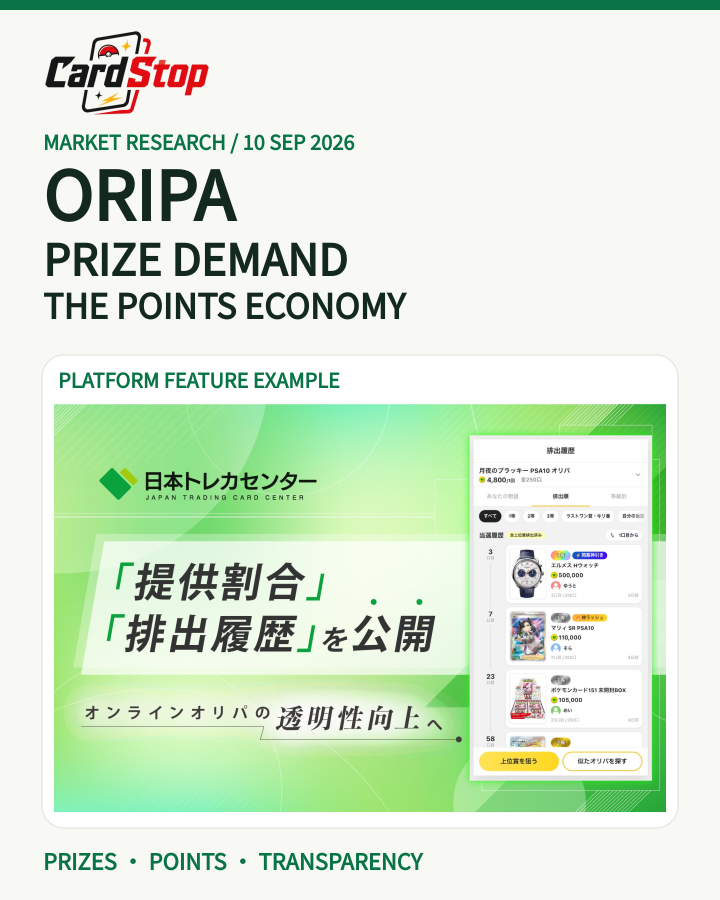
There are concrete disclosure improvements to examine. On 19 August, Japan Toreca Center announced initial allocation percentages and payout histories for fixed-count Oripa pools. The first lists opening quantities and proportions. The second appears after a pool sells out or closes, covering specified prizes including ranks one to three, last-draw and milestone rewards.[Japan Toreca Center feature announcement]
Opening odds, current remaining odds and post-pool records are different information. The announcement says displayed percentages describe the opening allocation; remaining proportions change as draws proceed. A history published after closure does not disclose remaining jackpots during sales. These features add information, but should not be described as an independent audit or regulatory certification.[Scope of published information]
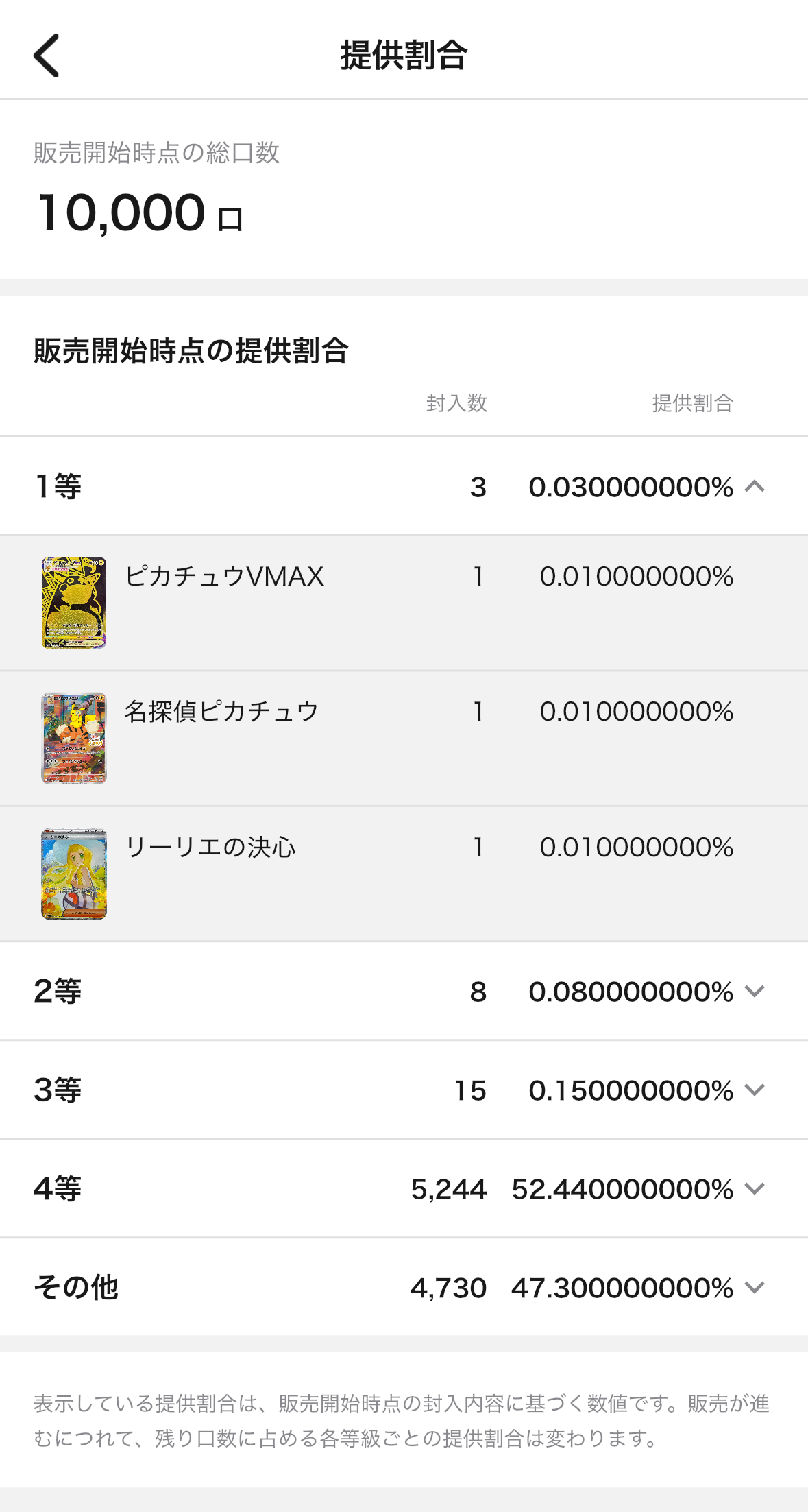 Initial composition: the publisher’s illustrative UI, not a live pool. The displayed first-prize count is 3 out of 10,000, or 0.03%.
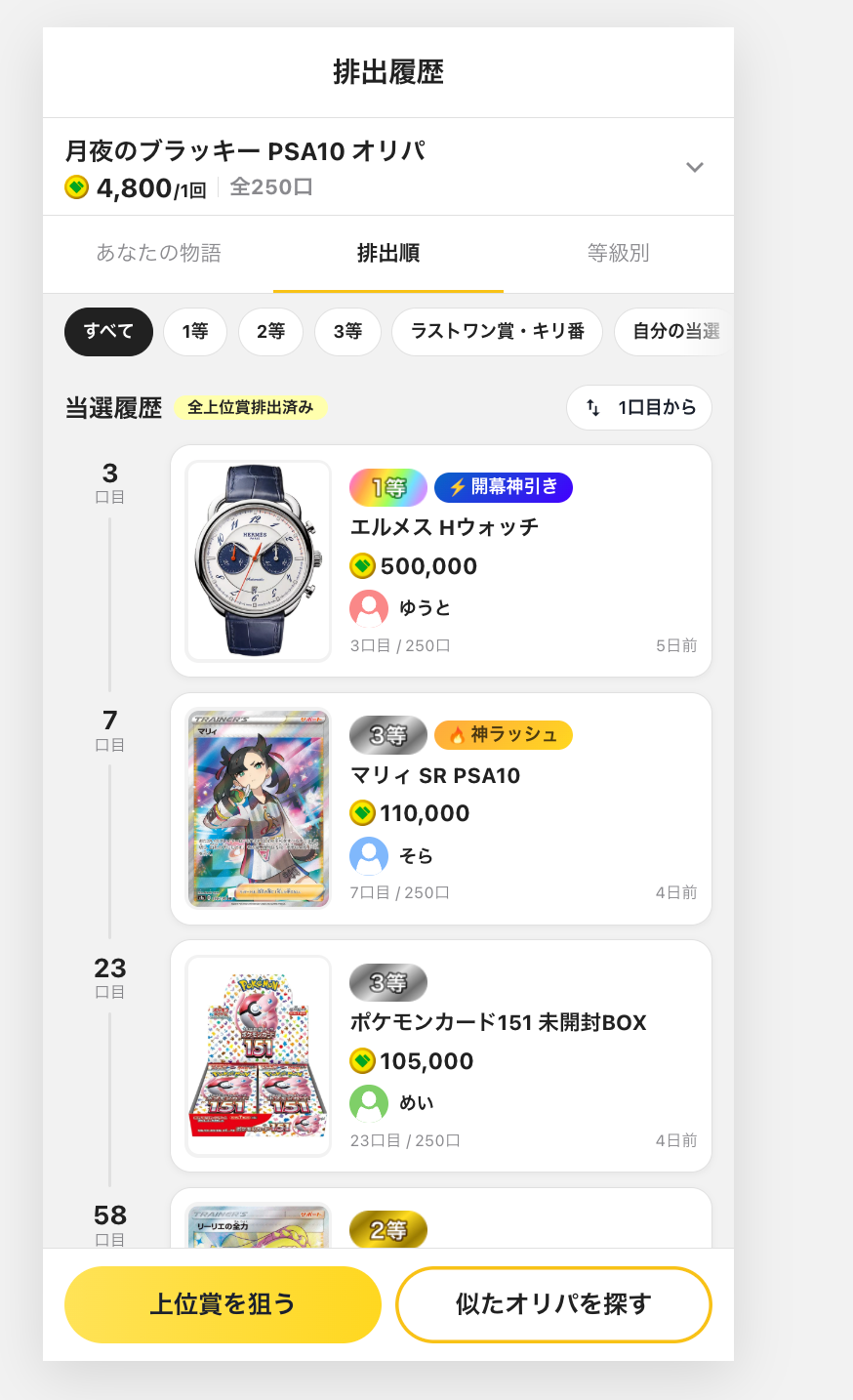 Payout history: the publisher’s illustrative UI for selected prizes after a pool closes. Displayed points are not yen or HK dollars.
The announcement predates the 7 September complaint, so it should not be presented as a response to that dispute. Each measure needs to be assessed against its actual introduction date. Better information can help users check a pool, but does not eliminate random outcomes, resale-price changes or overspending.
Remaining draw count alone cannot establish the chance of a particular prize. In a fixed pool drawn without replacement, with equal chances for remaining positions, the calculation also needs the number of target prizes left. If that is unknown, fewer remaining draws do not prove that a jackpot is approaching. The actual allocation rules still require checking.
Return percentages also require a defined measure of value. Platform points, advertised prize valuations and cash recovered after fees are different quantities. Even complete prize counts would produce an average based on the chosen valuation, not a guarantee for each participant. A few expensive prizes can raise that average while most outcomes remain much smaller.
A healthier market benefits from information that reduces avoidable mistakes: precise product specifications, checkable odds and delivery records, clear fees, and explanations that distinguish points from cash returns. Secondary trading needs better transaction records and buying terms. These help participants judge outcomes more effectively than attention focused only on animations or the highest advertised prize value.
Longer-term demand can still come from characters, artwork, competitive play and set history. These interests can coexist with resale, but collecting should not depend on a guaranteed higher-paying buyer later. When a purchase only works if someone else pays more, its owner also carries the risk that future buyers change their minds.
Participants can set spending and time limits before treating draws as paid entertainment. Reaching a budget is not a reason to add money to recover earlier spending: previous results create no profit guarantee for the next attempt. Repeatedly moving a limit is a reason to pause and review external payments, rather than judging expenditure only from remaining points.
The dispute’s eventual effect on Oripa remains uncertain. For now, separate the legal process, platform mechanics and personal cash needs. Alongside a card’s advertised value, ask who would buy it today, what they would pay and how long the transaction would take. Until those questions have firm answers, unsold cards and platform points should not be treated as immediately available cash.
Frequently asked questions
Has Japan banned online Oripa?
The verified event is a law firm’s investigation request announced on 7 September 2026. It is not a government finding or ban. As of 10 September, this review found no related public penalty or suspension announcement. Further developments require official documentation.
Would reduced Oripa buying necessarily lower Pokémon card prices?
No. Prize procurement can support particular cards, but collectors, dealers and overseas buyers also affect demand. Physical redemptions and resale could add supply while operator restocking adds demand. The net effect needs card-specific evidence.
Do platform points equal money that can be cashed out?
They should not be assumed equivalent. Permitted uses, refunds and transfers depend on the terms. Selling a physically delivered prize also requires a buyer, an agreed price and time. An advertised valuation does not guarantee cash proceeds.
Do PSA Japan’s changes affect existing applications?
The 10 September announcement sets different effective times for new applications to the relevant services. Earlier applications retain their previous terms. Local Hong Kong submission charges may additionally include transport, insurance and other costs, so check with the actual provider.
Research methods and sources
Cardstop compiled and analysed original public announcements and service explanations available as of 10 September 2026. Company releases describe their stated arrangements, not independent financial or probability audits. The market scenarios are conditional analysis, not causal findings established by Hong Kong transaction data.
- Hibiki Law Office: online Oripa investigation request (7 September 2026) ↗
- Japan Consumer Affairs Agency: 2026 releases ↗
- Japan Toreca Center: prize partnerships and categories (10 June 2026) ↗
- Japan Toreca Center: official service guide ↗
- Clove: official user guide ↗
- PSA Japan: service changes (10 September 2026) ↗
- PSA Japan: Value service clarification (10 September 2026) ↗
- PSA Japan: card grading service terms ↗
- Japan Toreca Center: allocation percentages and payout histories (19 August 2026) ↗